Job 33
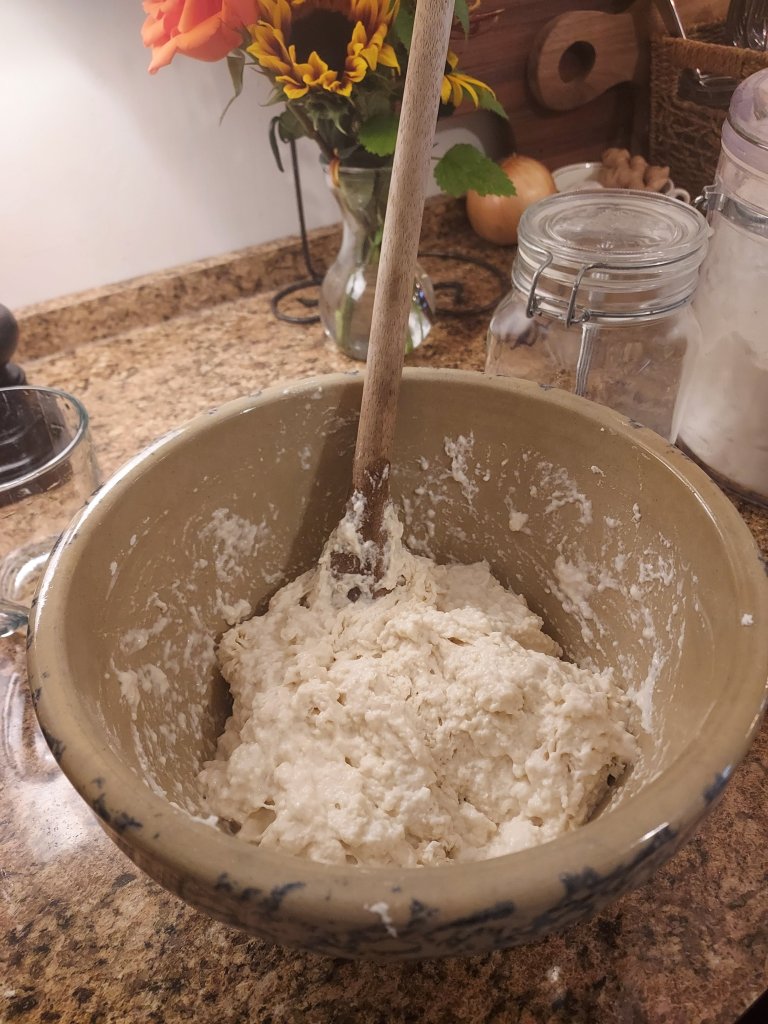
I use my mother’s hand thrown stoneware bowl; she gave it to me when Gram’s pink Pyrex bowl broke. Mom’s bowl is taller than Gram’s old Pyrex, so kneading the dough is a bit tricky. But I don’t knead the dough anymore – I have gained bread wisdom since the first rough loaves I baked as a newlywed homemaker. Time can do the kneading for me, and time is most valuable these days.

First, the flour. We feel so precious about the grains we use – are they genetically modified? Pesticide free? Bleached? Stone ground? I’ve tried a variety – whole wheat, einkorn, bleached white, gluten-free. For a time, I bought hard red and hard white wheat berries from a farm in Montanna and milled my own flour in a K-Tec kitchen mill. That was beautiful flour, and I’m excited to try it again. But for now, I use whatever flour I have in my flour crock. Yet again, bread wisdom prevails.
There are four ingredients in my favorite bread recipe. It is pan ordinaire in its simplest form. Flour. Yeast. Salt. Water. I add the flour to Mom’s bowl, around 3 or 4 cups. I add the salt, a teaspoon at least. Yeast – 1/4 of a teaspoon, definitely not more than 1/2 a teaspoon of active dry yeast. Then the water, 1 to 2 cups depending on the time of year and how humid the kitchen is. I stir them together in the bowl; the dough ends up very sticky and shaggy looking. This is exactly right. I cover the bowl with a towel and go to bed. The magic (science) happens as I sleep. In the morning, I’ll move the transformed dough into a greased and corn-mealed stoneware pie plate. It rises again for an hour before baking in a hot oven until the top is golden and the edges have pulled away from the pan. Fresh, hot bread for breakfast.
If you bake bread, you can likely remember the smell of it now, perhaps even the taste of it. Bread is basic in every culture across our planet. It’s a staple for most meals. But there are times when we forget the taste of bread – we forget to eat. Times of grief, trial, suffering, great loss, conviction over sin – these are the moments when our bread is like ash. Psalm 102 speaks to this:
“My heart is struck down like grass and has withered; I forget to eat my bread.”
“For I eat ashes like bread, and mingle tears with my drink…”
Psalm 102:4, 9
Elihu mentions this to Job – the loss of appetite for bread or even fine food. He reminds Job that God confronts His people about their sin, allowing them to feel miserable until they confess and repent.
“Man is also rebuked with pain on his bed and with continual strife in his bones, so that his life loathes bread,
Job 33:19–21
and his appetite the choicest food. His flesh is so wasted away that it cannot be seen, and his bones that were not seen stick out.”
In Job 33, Elihu continues his confrontation of Job, speaking to the sin he sees in Job and his friends. He says some good things, this younger man who showed up out of nowhere. Elihu reminds me of a younger me – the bread baker who knew all the ways to mix, knead, rise, and bake the bread. The new homemaker who found THE BEST wheat berries and THE BEST kitchen mill to make better whole wheat bread. If you had asked me then, I would have told you my curated ingredients and extensive methods were the only right way to make bread. Since then, I’ve gained a pinch of bread wisdom. This wisdom has taught me to use what I have (frugal) and do it in the time available (efficient) so that my household can have fresh bread in the morning.
Elihu isn’t wrong. He speaks truth. He seems to focus on God’s sovereignty and glory, God’s power and holiness. Yet, he lacks experience. Perhaps he lacks struggle and suffering. He hasn’t yet heard the LORD speak. He knows some things, and he is missing some information. Can we still learn from Elihu? Do his words have any wisdom for us? I believe we can find some wholesome bites of hearty bread in Elihu’s monologue.
Consider what Elihu says about God in chapter 33. He reminds Job that it is God who gives life and His Spirit; it is God who made us from dust, from clay (vv. 4-7). “God is greater than man” (v. 12). God does communicate, but man is deaf to it much of the time (v. 14); and it is God who helps man understand (vv. 15-18). God also is the one who convicts man of sin and “restores to man his righteousness” (vv. 19-28). When a man is restored to righteousness, he sings praises (v. 27-28) about his redemption so others can hear and know that God is gracious.
“Behold, God does all these things, twice, three times, with a man, to bring back his soul from the pit, that he may be lighted with the light of life.”
Job 33: 29-30
The bread has cooled. This loaf will be served with potato and sausage soup. I’ll add the kale greens and cream last so the greens can soften without losing their bright color. A little butter on the bread, a little dip into the hot soup…it is good.
Lord, let us remember Your goodness, mercy, and steadfast love as we remember the taste of our bread. Fill our hearts and minds with memories of Your wonderful works, Your righteousness, Your redemption, even as we, by Your grace, enjoy our daily bread.
 Christina Grubb